
Blogs
Shoulder Pain When Lifting Your Arm: What Could be Causing It?

Shoulder pain when lifting your arm can make everyday movements like reaching overhead or getting dressed uncomfortable. The location of the pain and movements that trigger it can offer clues about the cause.
At Zen Care, we evaluate how your shoulder moves and what may be contributing to your symptoms.
What shoulder pain when lifting your arm can feel like
Shoulder pain does not feel the same for everyone. You may notice:
- Sharp or pinching pain. This may happen only during a certain part of the movement.
- A dull ache. Your shoulder may ache during or after activity.
- Pain at the front or side of the shoulder. The location can sometimes help narrow down which tissues may be involved.
- Weakness. Your arm may feel weaker when you raise or lower it.
- Stiffness. You may have trouble moving your arm through its usual range.
- Pain with specific movements. Reaching overhead, out to the side, or behind your back may be especially uncomfortable.
Some people experience what is called a painful arc. This means the shoulder hurts during a certain portion of raising the arm but may feel better before or after that range. A painful arc can provide a clue, but it does not identify the cause by itself.
Common causes of shoulder pain when lifting your arm
Several muscles, tendons, joints, and other tissues work together every time you raise your arm. Problems involving any of these structures can make the movement painful.
Rotator cuff irritation or injury
The rotator cuff is a group of muscles and tendons that helps stabilize your shoulder and move your arm.
A rotator cuff problem may cause pain when you lift your arm overhead or away from your body. You might also notice weakness, nighttime pain, or discomfort when lying on the affected shoulder.
Rotator cuff problems range from irritation to more significant injuries. Our article about rotator cuff injuries and chiropractic care explains these injuries and available care options in more detail.
Shoulder impingement and bursitis
A bursa is a small fluid filled sac that helps reduce friction around a joint. When tissues around the shoulder become irritated, movements that reduce the available space in the shoulder can become painful.
Pain may be more noticeable when raising your arm to the side or reaching overhead. Some people also experience tenderness or pain when sleeping on the affected side.
These symptoms can overlap with rotator cuff problems, which is why the movement that hurts cannot confirm a diagnosis on its own.
Frozen shoulder
Frozen shoulder causes pain along with a significant loss of shoulder movement. The shoulder may gradually become harder to move, including when reaching overhead or behind your back.
One important clue is stiffness. With frozen shoulders, both pain and restricted movement can make everyday activities difficult.
The condition often develops over time and can go through different stages. Because other shoulder problems can also cause stiffness, an evaluation can help determine what may be limiting your movement.
Biceps tendon irritation
The biceps muscle connects to the shoulder through a tendon. Irritation in this area can cause pain near the front of the shoulder.
You may notice more discomfort when lifting, carrying something, reaching overhead, or performing repeated arm movements.
Pain coming from the neck
Not every painful shoulder starts in the shoulder itself.
Nerves from your neck travel into your shoulders, arms, and hands. Irritation in the neck or a nerve can sometimes cause pain around the shoulder.
Neck involvement may be more likely if shoulder pain occurs with neck pain, tingling, numbness, weakness, or pain that travels down the arm.
What your shoulder pain pattern may tell you
The movement that causes pain can provide useful information. However, these patterns are clues rather than diagnoses.
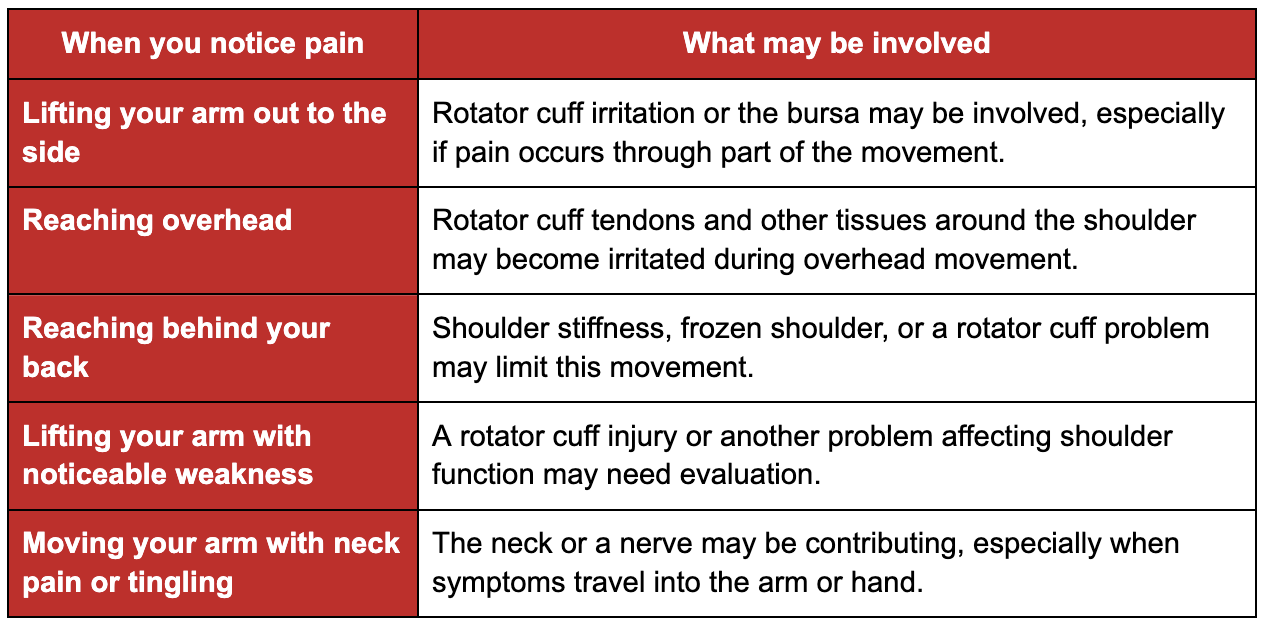
The same movement can hurt for different reasons. Rather than relying on one test at home, look at the overall pattern of your symptoms.
What to do when your shoulder hurts as you lift your arm
What you should do depends on how the pain started and how severe it is. For mild shoulder discomfort without a serious injury, a few simple steps may help while you monitor your symptoms.
- Modify activities that increase the pain. Temporarily reduce heavy lifting, repeated overhead movements, or activities that clearly make your symptoms worse.
- Keep the shoulder gently moving. Complete rest is not always helpful. Gentle movement within a comfortable range may help you avoid unnecessary stiffness. Do not force the shoulder through sharp pain.
- Consider ice or heat. Ice may feel helpful after an activity that irritates the shoulder. Heat may feel more comfortable for tight or stiff muscles. Protect your skin and avoid applying either for excessive periods.
- Do not push through worsening pain. Pain that becomes sharper or more intense with repeated movement is a reason to modify the activity rather than forcing through it.
- Pay attention to changes. Persistent pain, increasing weakness, significant stiffness, or symptoms that keep returning may warrant an evaluation.
When shoulder pain needs medical attention
Some shoulder symptoms should not be managed only at home.
Seek prompt medical attention if your shoulder looks deformed after an injury, you suddenly cannot raise your arm, or you develop significant weakness after a fall or other trauma. Severe swelling or numbness and weakness spreading down the arm also need appropriate evaluation.
Shoulder or arm pain can sometimes be related to a problem outside the shoulder itself. Seek emergency medical care if the pain occurs with chest pain, shortness of breath, sweating, dizziness, or other concerning symptoms.
How we evaluate shoulder pain at Zen Care
Because several conditions can cause similar symptoms, we focus first on understanding what may be contributing to your shoulder pain.
During an evaluation, we may consider:
- How and when your symptoms started
- Which arm movements trigger the pain
- Where you feel the discomfort
- Your shoulder range of motion
- Strength and overall function
- Posture and movement patterns
- Whether your neck may be contributing to your symptoms
This information helps us determine whether conservative care may be appropriate or whether further medical evaluation is needed.
Depending on your findings and individual needs, care may include chiropractic care and other supportive approaches available at Zen Care. The goal is to choose care based on what we find during your evaluation rather than assuming every case of shoulder pain has the same cause.
Finding the right next step for shoulder pain
Shoulder pain when lifting your arm does not always point to one specific condition. How the pain started, where you feel it, which movements trigger it, and whether you have weakness or stiffness all matter.
At Zen Care, we evaluate these factors before recommending an approach. When appropriate, conservative options such as chiropractic care and supportive therapies may be part of your care plan.
If shoulder pain is making everyday movement difficult or keeps returning, you can contact us to discuss your symptoms and determine an appropriate next step.
Frequently asked questions
Why does my shoulder hurt when I lift my arm?
Rotator cuff problems, bursitis, tendon irritation, joint stiffness, or neck issues can all cause pain when you lift your arm.
Why does my shoulder hurt when I lift it sideways?
Pain when lifting your arm sideways may be related to rotator cuff irritation, bursitis, or other shoulder problems.
Why does my shoulder hurt when I reach overhead?
Overhead movements can aggravate irritated rotator cuff tendons, the bursa, or other tissues around the shoulder.
Can a pinched nerve cause shoulder pain?
Yes. A pinched nerve in the neck can cause shoulder pain, sometimes with tingling, numbness, or weakness in the arm.
When should I get shoulder pain checked?
Get it checked if the pain persists, keeps returning, limits movement, or occurs with significant weakness or stiffness.