
Blogs
Herniated Disc vs Bulging Disc: What’s the Difference?

Herniated disc vs bulging disc can be confusing because the two conditions sound similar and can cause many of the same symptoms. The main difference is what happens inside the disc.
A bulging disc pushes outward while the outer layer stays intact. A herniated disc has a tear that allows some of the inner material to push through. Understanding this difference can help explain your symptoms and guide the next steps in care.
A Chiropractor in Irvine CA can evaluate your symptoms, nerve involvement, and spinal function to determine whether a disc problem may be contributing to your pain.
What a disc in your spine actually does
Each disc sits between two vertebrae in your spine and does two jobs. It absorbs load, and it works as a flexible joint, allowing the spine to move without the bones grinding together. Almost all trouble starts when one of those two jobs gets harder.
Every disc has two parts. The outer layer of a spinal disc is tough and fibrous, and inside sits a soft gel centre. The outer layer of the disc holds that centre under pressure the way a tyre wall holds air.
Age, repeated loading, and disc degeneration all dry the centre out and weaken the wall. That is where both problems start.
Key differences between bulging and herniated discs
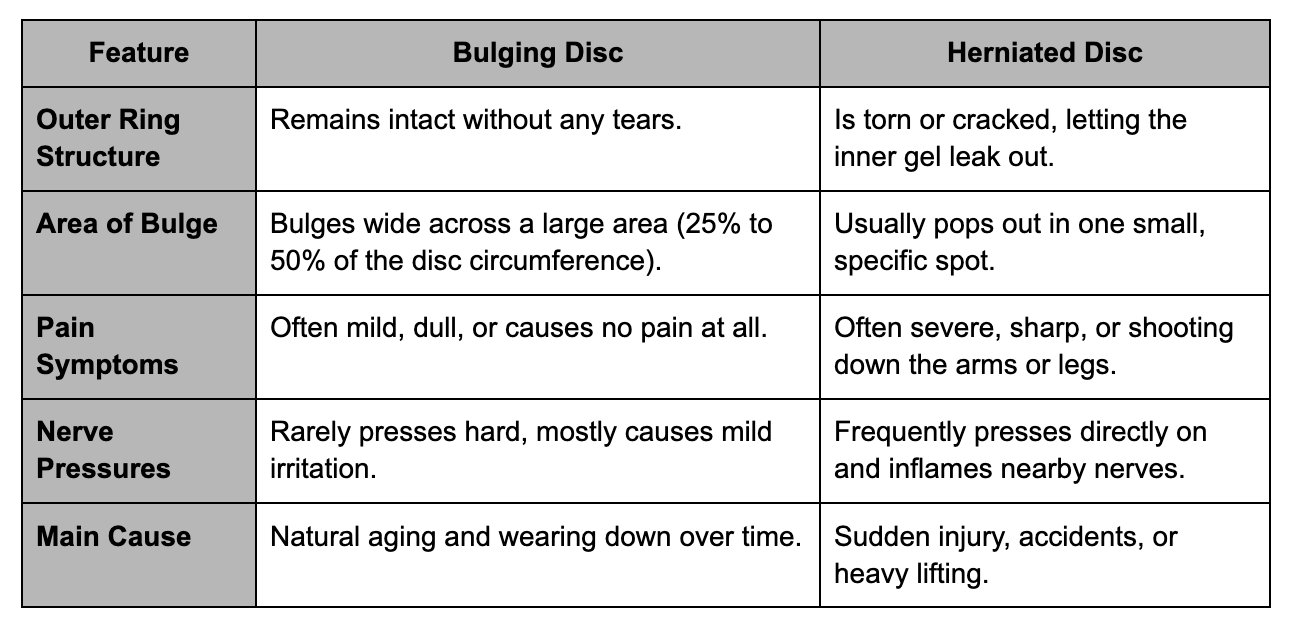
The plain language summary of bulging disc vs herniated disc: one is a stretched wall, the other is a leak. That is the bulging disc and herniated disc question settled in a sentence.
How a bulging disc forms
A bulging disc occurs as the outer wall weakens and the whole spinal disc pushes outward beyond its normal edge, usually around at least a quarter of its circumference. Nothing has broken. The disc is simply wider than it used to be, and this disc typically develops slowly over years.
Because pressure spreads across a broad area, the disc may sit quietly for years and may not always cause symptoms. Bulging discs often turn up by accident on a scan taken for something else.
How a herniated disc forms
A herniated disc occurs when the outer layer of the disc tears and part of the disc pushes through the gap. That torn wall is the whole distinction between the two. You may also see it called a ruptured disc, a slipped disc, or a protruding disc, though nothing actually slips and no disc ruptures like a balloon.
The escaped material can press directly on nearby nerves and, separately, trigger inflammation around them. Herniated discs are more likely to hurt because contact with the nerve is focal rather than spread out, and a herniated disc involves chemical irritation that a bulge does not. That combination is why herniated discs can cause significant leg pain from a very small amount of displaced disc material.
Symptoms of each disc problem
A bulging disc and a herniated disc can cause similar symptoms, so back pain alone may not tell you which one you have. The difference is often clearer when a nerve is affected.
- A bulging disc may cause no symptoms or a dull ache that gets worse with sitting.
- A herniated disc is more likely to cause sharp or shooting pain that travels down an arm or leg.
- Numbness, tingling, or weakness can happen when a nearby nerve is affected.
- Pain may improve or worsen when you change positions.
- Symptoms in both legs or changes in bladder control need urgent medical attention.
A bulging or herniated disc can also narrow the spinal canal and cause heaviness or weakness in the legs when walking. In some cases, a disc problem in the neck or upper back can put pressure on the spinal cord and cause more serious symptoms.
See more: What Causes Numbness and Tingling?
How disc conditions are diagnosed
Diagnosis usually starts with a review of your symptoms and a physical exam. Your provider may check your strength, reflexes, sensation, and movement to see if a nerve may be affected.
An MRI can show the discs, nerves, and other soft tissues in the spine. A CT scan may be used when more detail about the bones is needed or when an MRI is not an option.
Imaging results are then compared with your symptoms and physical exam. This helps determine whether the disc changes seen on the scan are actually related to your pain.
Treatment options for bulging and herniated discs
The good news is that care for both starts in the same place, and most people never reach the later steps. The characteristics and treatment approaches differ mainly in how fast things change.
- Conservative treatment first. Relative rest for a few days, then movement. Physical therapy or chiropractic care to restore mechanics and reduce load on the affected level.
- Decompression therapy. Gentle traction that lowers pressure inside the disc and can help draw the protruding material back toward the centre.
- Medication and steroid injections. Useful when inflammation around the nerve is the main driver rather than the mechanical pressure.
- Surgical intervention. Reserved for progressive weakness, unmanageable pain after months of conservative care, or bladder and bowel changes.
Treatment for bulging discs leans on movement and load management, since there is no leak to resolve. A herniated disc may require more aggressive treatment early if a nerve is under real pressure, though many settle without it. Your course of treatment should follow your symptoms, not the wording on the report.
Discs can heal. The body reabsorbs escaped material over months, which is why a herniation that looks alarming in January is often unremarkable by summer. Conditions like bulging discs change more slowly but respond well to consistent load management.
Getting an answer that fits your spine
Two people can have similar scans but experience very different symptoms. That is why treatment should be based on your symptoms, physical exam, and how your spine is functioning, not just what appears on an MRI.
At Zen Care in Irvine, we assess the spine, nerve involvement, and movement to determine which treatment options may be appropriate. Depending on your condition, care may include chiropractic care, decompression therapy, and other conservative approaches.
If you are unsure what your scan results mean or what may be causing your symptoms, contact us to discuss your concerns and find the next step that fits your needs.
Frequently asked questions
Which is more serious?
A herniation usually is, since the wall has torn and pressure on nerves tends to be focal rather than spread out. That said, a large bulge in a narrow spinal canal can cause more trouble than a small tear.
Can a bulge turn into a herniation?
Yes. Continued loading on an already weakened wall raises the risk of developing a herniated disc, which is why the development of bulging discs is worth taking seriously even without pain.
How long does each one take to improve?
Most herniations improve substantially within six to twelve weeks with conservative care. Bulging discs change more slowly, and treatment focuses on symptoms and function rather than the scan.
Do I need surgery for a herniated or bulging disc?
Most people do not. Surgery becomes a real conversation when weakness is progressing, when severe symptoms persist despite months of care, or when there are bladder or bowel changes.
Does a bulging disc or a herniated disc show up on every MRI?
Close to it, past a certain age. That is exactly why the finding has to be matched to your examination rather than treated on its own.